Basics

216 N Marshall Ave

Litchfield MN 55355

(320)693-2483

All Pioneerland

While all Pioneerland Library System buildings remain closed to the public due to the COVID-19 pandemic, Curbside Pick-up of library items is available. You may place items on hold using the online catalog. Library staff will call you to schedule a pickup time once your hold is ready. Pickup days/times vary by location. Please contact your library if you have questions or need assistance in using this service.

Showing posts with label history. Show all posts

Friday, June 7, 2019

Ordinary and Extraordinary Heroes of World War II


by Beth Cronk, Litchfield head librarian

With the recent 75th anniversary of D-Day, the world has had a chance to honor the Allied troops who invaded Normandy in 1944 in the largest combined land, air, and naval operation in history.  It was remarkable to hear about the veterans in their nineties who commemorated the anniversary by once again parachuting into France as they had as young men.  The anniversary gives us an opportunity to remember the troops who gave their lives – over 4000 Allied troops on D-Day alone – and to learn more about all who did their part to fight tyranny in World War II.

World War II at Sea: A Global History is a definitive naval history of the war.  Author Craig L. Symonds wrote a narrative history of the engagements, the people, and the strategies, beginning with the London Conference of 1930 and ending with the surrender in Tokyo Bay in 1945.  It includes accounts of U-boat attacks, Dunkirk, Pearl Harbor, Midway, and Normandy.  Symonds explains with historical details that naval operations were key to the outcome of the war. 

If you like your history as historical fiction, you may enjoy The Paris Spy by Susan Elia MacNeal.  One of the most recent in the Maggie Hope mystery series, this one finds American-born British spy Maggie working in occupied Paris.  Another agent was gathering research for the impending invasion of Normandy when she was captured, and Maggie needs to locate that information for England while working to discover a traitor and find her missing sister. 

For some inspirational true stories, look for the brand-new book Invisible Heroes of World War II: Extraordinary Wartime Stories of Ordinary People by Jerry Borrowman.  These are not the stories of the generals and world leaders.  These are soldiers, ordinary citizens working with the resistance, journalists, combat engineers, code breakers, and factory workers. 

A biography of one of those unknown heroes is very popular right now.  A Woman of No Importance: The Untold Story of the American Spy Who Helped Win World War II is a bestseller by Sonia Purnell.  Virginia Hall was a Baltimore socialite who loved studying languages and who lost her leg in a hunting accident.  She worked for the State Department in Europe and then joined Churchill’s spy organization SOE in occupied France.  While posing as a newspaper reporter, she was crucial to building the French resistance and building a network of spies. At one point, the Gestapo considered her the most dangerous of all Allied spies.  Reviewers say this biography is fast-paced and gripping.

Mistress of the Ritz by Melanie Benjamin is a novel based on the true story of another American woman who worked for the French Resistance.  Blanche Auzello was an American actress who married the French hotel manager who took over the Ritz in its glory days.  When the Nazis set up their headquarters in their Paris hotel in 1940, the Auzellos hosted them while secretly working against them.  In addition to the tension of that situation, the Auzellos’ marriage was in trouble throughout their years together.  Reviews say this novel is well-researched and written in a compelling way, with historical figures like Coco Chanel and Ernest Hemingway appearing as supporting characters.

When it comes to such a huge, worldwide conflict, there are endless stories to be told.  Look for the D-Day display at the Litchfield Library to find even more books about this pivotal time in history. 

Tuesday, July 3, 2018

Celebrate Your Freedom to Read


by Beth Cronk, Meeker County Librarian

Happy Independence Day!  “We hold these truths to be self-evident, that all men are created equal…” These words from the Declaration of Independence remain inspiring and relevant today, 242 years after they were written.  This week we celebrate America, in all of its imperfect glory.  

Our founding documents are essential for all Americans to read.  The National Archives have the Declaration of Independence, the Constitution of the United States, and the Bill of Rights available to read at www.archives.gov/founding-docs.

You can also find them in our new library book, The Handy American Government Answer Book: How Washington, Politics, and Elections Work by Gina Misiroglu.  This resource also explains how Congress and the courts work, what the roles and responsibilities of the president are, what civil liberties and civil rights are, plus a number of other issues related to how our government works.  It’s all organized in a question and answer format; for example: “Why was Samuel Adams called the Father of the American Revolution?” “What is the role of the first lady?” and “How are interest groups regulated by the government?”

Thomas Paine said, “It is the object only of war that makes it honorable.  And if there was ever a just war since the world began, it is this in which America is now engaged.” (This and all quotations in this article are from Bartlett’s Familiar Quotations, 2012) You can read about this war in our new book, The West Point History of the American Revolution.  This history covers everything from the causes of the revolution and its first battles to Yorktown and beyond, discussing the adoption of the Constitution and the formation of our country. 

For some perspective on our current era, Jon Meacham wrote The Soul of America: The Battle for our Better Angels.  The phrase comes from Lincoln’s First Inaugural Address: “The mystic chords of memory...will yet swell the chorus of the Union, when again touched, as surely they will be, by the better angels of our nature.” In this new book, Pulitzer Prize-winner Meacham examines other critical times in American history when fierce partisan division threatened our country.  He reminds us that we have faced political turmoil many times in the past, and we have come through better than before. 

George Washington said, “I had always hoped that this land might become a safe and agreeable Asylum to the virtuous and persecuted part of mankind, to whatever nation they might belong.”  Mohammed Al Samawi fled Yemen for the United States in 2015.  In his new book The Fox Hunt: A Refugee’s Memoir of Coming to America, Al Samawi tells his story of becoming an interfaith peace activist after secretly reading a copy of the Bible.  Extremists in Yemen threatened his life for working with Jewish and Christian people, and then he was trapped in his apartment in the midst of a battle.  He reached out on Facebook for help, and four Americans helped him get out.  This suspenseful story is being developed into a movie. 

At the signing of the Declaration of Independence, Benjamin Franklin said, “We must all hang together, or assuredly we shall all hang separately.”  James and Deborah Fallows traveled the country for the past five years doing research for their new book Our Towns: A 100,000-Mile Journey into the Heart of America.  They found people in middle America banding together to find practical solutions to societal problems, and the book is quite optimistic.  Duluth, Minnesota, is one of the cities featured. 

Thomas Jefferson said, “If a nation expects to be ignorant and free, in a state of civilization, it expects what never was and never will be.”  This week we celebrate our freedom.  May we, like Jefferson, be curious readers who are always looking to improve our minds and education, for the benefit of our wonderful nation. 

Friday, May 18, 2018

The Civil War, 150 years after the first Memorial Day


by Beth Cronk, Litchfield head librarian

Did you know that Memorial Day was originally called Decoration Day?  It was first widely observed 150 years ago, in 1868, as a way to remember the soldiers who had died in the Civil War.  The library has a number of recent books about the American Civil War for those who enjoy learning about our history.

The popular new novel Varina is the latest by Charles Frazier, author of Cold Mountain.  Teenage Varina Howell married the much-older widower Jefferson Davis in 1845, never imaging more than a quiet life in Mississippi.  With her grandfather involved in politics in the north, her own education in Philadelphia, and the first fifteen years of her marriage spent in Washington, D.C., Varina was conflicted about both the war and slavery, and she was not pleased when her husband became president of the Confederacy.  The novel includes her flight south with her children, with Union soldiers in pursuit as the Confederacy fell.  After her husband’s death, Varina moved to New York City and became close friends with Julia Grant, Ulysses’ widow.  This well-written book asks still-relevant questions about whether Varina was complicit in the things her husband did.

Speaking of Ulysses S. Grant, Pulitzer Prize-winning author Ron Chernow wrote another respected biography in the past year, this one simply titled Grant.  From business failures, corrupt staff members, alcoholism, and a resignation from the army in disgrace, to rapid advancement, military and political success, and literary acclaim, Grant’s life swung back and forth between bad and good fortune many times.  Chernow makes the case that Grant was one of America’s best but most underappreciated presidents.

Another biography, Stanton: Lincoln’s War Secretary tells the story of Edwin Stanton, the powerful and controversial man who raised an army for the Union.  Lincoln’s right hand man, Stanton supervised the army from his telegraph office.  He had thousands of people imprisoned for supposed war crimes, which included things like calling for an armistice.  When Lincoln was shot, the former attorney quickly took charge, informing the public, directing General Grant to secure the Capitol, and collecting evidence from the crime scene.  Published last year, this was the first biography of Stanton in fifty years, so he isn’t a familiar figure to many of us.

The Thin Light of Freedom: The Civil War and Emancipation in the Heart of America is a recent Civil War history.  Reviewers say that author Edward L. Ayers deeply researched the material and wrote an engaging narrative with a fresh perspective on the familiar events.  This book focuses on the Great Valley on both sides of the Mason-Dixon line: the counties of Augusta, Virginia and Franklin, Pennsylvania.  From this vantage point, Ayers examines battles, the destruction of property in war, families who sent soldiers to the front, and the hope and reality of emancipation. 

Other classic and recent books about the Civil War are always available at the library.  Look under the Dewey Decimal area 973.7 in nonfiction, or do a keyword search for “United States history Civil War fiction” in the catalog to find novels. 

Friday, October 6, 2017

Don't Know Much About History

by Beth Cronk, Litchfield head librarian

George Santayana said, “Those who cannot remember the past are condemned to repeat it.”  Authors are always coming out with new books about history to teach us about the past, and our library has a number of recently-published choices.

Starting way back in 247 B.C., Patrick N. Hunt’s biography Hannibal gives readers an opportunity to learn about one of the great generals of the ancient world.  Hannibal Barca of Carthage (which is now Tunisia) crossed the Alps with war elephants to invade Italy.  It’s a little hard to imagine!  Hannibal’s tactics are still taught in military academies, and generals from Napoleon to Norman Schwarzkopf have studied and admired him. 

Moving ahead just over two thousand years, another recently-published book covers the experiences of the first American women in the Army.  The Hello Girls: America’s First Women Soldiers by Elizabeth Cobbs Hoffman tells the story of the women who served in the Army’s Signal Corps in World War I.  General Pershing needed experts to run telephone switchboards to keep the commanders in touch with the troops under fire, and women were the experts in this new technology. The Hello Girls faced many kinds of challenges in the war zone, sometimes serving directly on battlefields.  When they were discharged after the war, they received no veterans’ benefits until a handful of survivors finally won those in 1979. 

The book Istanbul: A Tale of Three Cities covers a massive range of history and prehistory, from 800,000 BC to the present.  British historian and TV documentary producer Bettany Hughes has written what some are calling a biography of the city that has been named Byzantium, Constantinople, and Istanbul.  It has been the capital city of the Roman, Byzantine, and Ottoman Empires and for a long time was the most important city in the world.  Hughes writes with an enthusiastic narrative style, full of details and drama.

Ken Burns is America’s favorite TV documentary-maker.  His new one is The Vietnam War, which we will be getting on DVD for the library.  The companion book is The Vietnam War: An Intimate History, co-authored with Geoffrey C. Ward.  Full of photographs, this book gives as comprehensive a look at this controversial war as you are likely to find, from its causes to its legacy.

For a fresh look at the Revolutionary War, check out Scars of Independence: America’s Violent Birth by Holger Hoock.  The publisher’s description of the book says, “The American Revolution is often portrayed as an orderly, restrained rebellion, with brave patriots defending their noble ideals against an oppressive empire.”  The author sets aside the usual nostalgia to examine the brutal violence that both sides engaged in, including the torture of Loyalists, the rape of colonial women, the starvation of prisoners, and the genocidal campaign against the Iroquois.   


Other new books about historical topics include Stanton: Lincoln’s War Secretary by Walter Stahr, Ike and McCarthy: Dwight Eisenhower’s Secret Campaign Against Joseph McCarthy by David A. Nichols, and The Kelloggs: The Battling Brothers of Battle Creek by Howard Markel.  Learn more about history by picking up a book about a time or topic that’s new to you.  

Friday, April 22, 2016

Book award season

by Beth Cronk, Litchfield head librarian

Let’s talk book awards.  This past week brought us book awards big and small, with the Pulitzers and the Minnesota Book Awards, and our library has a number of them available for you to check out.

The Sympathizer by Viet Thanh Nguyen won the Pulitzer Prize for fiction.  Although this book has gotten great reviews and has been up for other literary awards, not many people have heard of it.  A mixture of thriller and satire, this novel is described as smart and perspective-changing.  The narrator is a Viet Cong secret agent who evacuates with the last of the South Vietnamese flying out of Saigon.  He then continues to spy on a general and others as they start a new life in Los Angeles in the ‘70s. 

The Pulitzer for history went to Custer’s Trials: A Life on the Frontier of a New America by T.J. Stiles.  This biography digs into who George Armstrong Custer was as a person, intense and full of contradictions.  The author focuses on how Custer lived on a frontier in a sense of the time period, uncomfortably navigating the major changes in society that came in the middle of the nineteenth century.  Expect to have your ideas about Custer challenged if you read this one.

The Minnesota Book Award for general nonfiction was awarded to No House to Call My Home: Love, Family, and Other Transgressions by Ryan Berg.  Berg was a caseworker in a group home for homeless lesbian, gay, bisexual, transgender, and questioning (LGBTQ) teens in New York.  Twenty to forty percent of homeless teens in the United States are LGBTQ, mostly because of family conflict and often because their parents have forced them out of the house.  Berg attempts to find patterns in the stories of the kids he worked with, trying to figure out what would help them build healthy relationships and successful lives once they aged out of the foster care system.

Erin Hart’s The Grave Soul won the Minnesota Book Award for genre fiction.  This is the 23rd book in her Jane Lawless mysteries series, which has been going since 1989.  Jane is a (fictional) Minneapolis restaurateur and private investigator.  In this installment, Jane is hired by a man who wonders if his girlfriend’s recurring nightmare about her mother being murdered is true, even though it doesn’t agree with her family’s account of how she died. 

The Minnesota Book Award for memoir and creative nonfiction went to Karen Babine for Water and What We Know: Following the Roots of a Northern Life.  Babine’s essays explore how the land affects the people who live on it, and how water is a part of human stories.

Minnesota Modern: Architecture and Life at Midcentury by Larry Millett won the Minnesota award given by the Minnesota Book Awards.  How’s that for enough uses of the name of our state?  Millett is known for books on Minnesota architecture, such as Lost Twin Cities and Once There Were Castles, as well as a series of novels about Sherlock Holmes in Minnesota.  “Minnesota Modern” explores houses and public buildings that were built between 1945 and the mid-1960s. 


The Litchfield Library has copies of all of these books, as well as There’s Something I Want You to Do by Charles Baxter, the winner of the Minnesota Book Award in the novel and short story category, and Red: A Crayon’s Story by Michael Hall, the winner in children’s literature.  Other Pulitzer Prize and Minnesota Book Award winners are available to order in our catalog.  Enjoy some of the best writing our nation and our state have to offer.

Friday, July 31, 2015

Truth as interesting as fiction

by Beth Cronk, Litchfield head librarian

While novels are always popular, many people like a fascinating true story.  Some nonfiction books can be read cover to cover just like a novel.  They could be true crime, memoir, history, or a host of other things.  Following are a few of our new books that you could lose yourself in this summer.

The Billion Dollar Spy: A True Story of Cold War Espionage and Betrayal by David E. Hoffman tells the story of a Soviet engineer who handed over technological secrets to the U.S. in the late ‘70s.  Adolf Tolkachev was considered one of the most valuable spies to work for the U.S.  The Washington Post calls the book “one of the best spy stories to come out of the Cold War and all the more riveting…for being true.”

Smokejumper: A Memoir by One of America’s Most Select Airborne Firefighters by Jason A. Ramos and Julian Smith gives a glimpse into the work of wilderness firefighters who parachute into fire zones.  Ramos is an active-duty jumper with 26 years of experience.  He tells the history of smokejumping, explains why it needs to be done, and shares his personal adventures on the job.

Does This Beach Make Me Look Fat? True Stories and Confessions is a collection of humorous essays by novelist Lisa Scottoline and her daughter Francesca Serritella.  The stories and reflections are all very short, so you don’t have to have a long stretch of time to get into this book.  Scottoline and Serritella have written several books like these, which have been compared to Erma Bombeck’s work (though not as good).

Primates of Park Avenue: A Memoir by Wednesday Martin is an outsider’s perspective on upper class mothers in New York City.  Martin is a writer and social researcher with a background in anthropology. She struggled to fit in with the women in her new neighborhood and turned to primatology to make sense of the hierarchy and behavior.  The book has funny observations on how humans are like baboons in establishing dominance, engaging in display rituals, and mating.  It also has some surprisingly touching reflections on motherhood and female friendship. 

If you’d like some armchair travel, Peaks on the Horizon: Two Journeys in Tibet by Charlie Carroll could fit the bill.  Carroll became obsessed with Tibet in grade school when he checked out Seven Years in Tibet from the library.  He got to visit as an adult on sabbatical from his teaching job, and on the border between China and Tibet he met Lobsang, a Tibetan exile who’d had to flee through the Himalayas at the age of five.  The book tells Lobsang’s story, as well as Carroll’s story of visiting the country.  Reviewers say it’s suspenseful and enlightening.

The Oregon Trail: A New American Journey by Rinker Buck is also a travelogue, but a very different one.  Buck traveled the 2000-mile Oregon Trail in a covered wagon with a team of mules, along with his brother and his dog.  It took them four months to go from St. Joseph, Missouri, to Baker City, Oregon, contending with thunderstorms, runaway mules, vanished sections of the trail, the Rocky Mountains, and many broken wheels and axels.  Besides telling the story of their own journey, the book also tells the history of the trail and the 400,000 people who went west on it.  Being compared to Bill Bryson’s A Walk in the Woods and sounding somewhat similar to Cheryl Strayed’s Wild, this one has gotten fantastic reviews.


Truth can be stranger than fiction, and just as entertaining.  Consider adding some nonfiction to your summer reading list.

Wednesday, November 26, 2014

Popular books for the people on your shopping list

by Beth Cronk, Litchfield head librarian

As you work on your Christmas shopping, are you looking for some book ideas for people on your lists?  I can tell you which new titles are popular in our library system.  One of these might be just the right thing for someone you know
.
Killing Patton: The Strange Death of World War II’s Most Audacious General is the latest in the Bill O’Reilly and Martin Dugard “Killing” series.  In this one, the authors question whether the general’s death from injuries sustained in a car accident was really accidental.  It’s the in-demand book in our library system right now.  For the history buffs and conspiracy theorists on your list.

The last book in Nora Roberts’ Cousins O’Dwyer trilogy has just come out.  Blood Magick wraps up the series about the Dark Witch gift shop in County Mayo, Ireland, and the owner’s forbidden romance.  For fans of Nora Roberts and paranormal romance.

John Grisham has a new novel out, Gray Mountain.  This is his 27th to be published.   A young lawyer is laid off from her comfortable New York job and ends up working in legal aid in Appalachia.  This is the first time Grisham has had a female main character.  For fans of legal thrillers and those who care about environmental causes. 

Laura Ingalls Wilder’s autobiography has just been published and is expected to be available from booksellers this month after a couple of delays this fall.  Pioneer Girl: The Annotated Autobiography is a project of the South Dakota State Historical Society, which is a very small publisher.  This is Laura’s first draft of her life story, written in 1930 before she began her novels.  This book contains new background research by the historical society that gives context to Laura’s story.  It should be interesting to see which stories were left out of the eventual series because they were too mature for children, as well as to find out what Laura’s original writing was like.  This book is on my Christmas list, and I keep hearing that other people are asking for it, too.  For Little House fans, obviously.

Stolen from the Garden: The Kidnapping of Virginia Piper is the true story of a wealthy socialite who was kidnapped for ransom in Orono in 1972.  Author William Swanson reviewed documents about the case and interviewed many of the people who were closely involved.  In the end, Swanson makes his case for what he thinks really happened.  For fans of true crime.

James Patterson books are always popular, and this is true for the latest Alex Cross novel, Hope to Die.  Patterson has a new book out every other month or so, pairing up with other writers to pump them out.  This one appears to be written by Patterson himself, and the reviews are good.  Detective Alex Cross is battling a psychotic genius to get his family back.  This isn’t the place to start reading the series, so it would be for people who are already fans of these thrillers.

Lila is the latest novel from Pulitzer Prize-winner Marilynne Robinson.  It tells the story of the minister’s wife from Robinson’s novel Gilead, who is the mother of the main character of her novel Home.  It isn’t necessary to have read the other two books, however.  This novel tells of Lila’s difficult years of abuse and homelessness and how she adjusts to her new life with such a past.  For literary readers. 


One good thing about library books is that you can check them out for free before you decide if you want to buy a copy for yourself.  The titles I’m covering here have waiting lists because they are so popular, so you may or may not have the chance to borrow these before Christmas.  But we have shelves full of so many other things that you can preview before you make your Christmas list or do your shopping.  Have a happy holiday season!

Friday, August 15, 2014

Commemorating the 100th anniversary of WWI

by Beth Cronk, Litchfield head librarian

This month marks the 100th anniversary of the First World War.  Archduke Franz Ferdinand was assassinated on June 28, 1914. A month later, Austria-Hungary declared war on Serbia.  In the first days of August, Germany declared war on Russia, France, and Belgium.  On August 4, Germany invaded Belgium, beginning the war itself, which would last over four years. 

We will be seeing commemorations of the Great War, as it was first known, over the next few years, especially once we get to 2017, the 100th anniversary of the United States’ involvement in the war.  Most people know far less about World War I than World War II.  Following are some of the recent books we have on World War I that can help fill in your knowledge of this era that truly changed the world.  Many of them focus on the events that happened at the beginning of the war, exactly 100 years ago.

We have three books published in 2013 that analyze the causes of the war and the events leading up to its beginning.  Catastrophe 1914: Europe Goes to War tells the story of the outbreak of the war, from the breakdown in diplomacy to the end of 1914.  British historian Max Hastings makes the case that Germany and Austria-Hungary were mostly to blame, and he argues against the typical judgment that the war was pointless, making the case that Germany had to be defeated for the sake of the freedom of Europe.

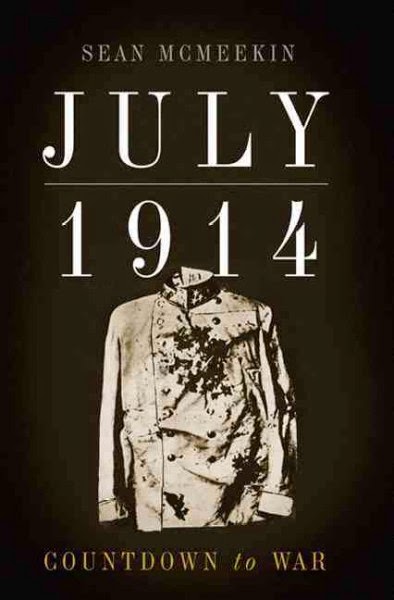
In July 1914: Countdown to War, author Sean McMeekin takes a different, more controversial perspective.  He argues that a small group of statesmen in Russia and France, in addition to Germany and Austria-Hungary, sought to start the war.  He bases his case on gaps in documentation that suggest that important players in these countries destroyed and doctored evidence, and on surviving correspondence in which these politicians blame their opponents for starting the war.

The Sleepwalkers: How Europe Went to War in 1914 is yet another analysis of the causes of the war.  Author Christopher Clark starts the book with a thorough explanation of the European, especially Balkan, politics that set the scene for the war to begin.  The rest of the book is a scholarly analysis of the beginnings of the conflict, with Clark carefully avoiding placing the blame on any countries or individuals.


 The Long Shadow: The Legacies of the Great War in the Twentieth Century was just published in the U.S. in May.  It was written by a University of Cambridge historian, David Reynolds, and it won the 2014 PEN Hessell-Tiltman Prize, a British award for the best work of history.  Reynolds argues that we are still struggling to understand the First World War.  He analyzes the impact of the war on the period between world wars and after World War II, showing that global attitudes and ideas changed significantly because of it.

The Great War: A Photographic Narrative is probably the best anthology of World War I photographs ever printed.  The photos come from the collections of the Imperial War Museum in London, curated by Hilary Roberts.  The book is organized by year, showing the history of the war from the arms race to the armistice, through 305 photographs. 


Look for more books and media coverage on World War I in the next few years that will cover many aspects of the war as it unfolded.  Understanding history is important to understanding the world we live in now.

Monday, August 12, 2013

Remembering the Dakota Conflict

by Beth Cronk, Litchfield head librarian

Although the Dakota Conflict was especially on our minds last year because it was the 150th anniversary, we are again at the anniversary in the middle of August.  Many local people come to the library looking for books on the history of the war, and our collection does include many books about it, old and new. 

One of the newest is practically a pamphlet at 22 pages.  Red Earth, White Road by Janet Timmerman is part of the Rural and Regional Essay Series.  The series is supported and distributed by the Society for the Study of Local and Regional History at Southwest Minnesota State University.  Red Earth, White Road tells the true story of the LaFramboises, a mixed-race family caught between the two sides of the U.S.-Dakota Conflict. 

Birch Coulie: The Epic Battle of the Dakota War is a nonfiction account of the decisive battle, written by John Christgau and published in 2012.  It should not be confused with the 1957 novel Birch Coulie by Bernard Frances Ederer, which we also have in the library.  The Christgau book is described as dramatic but accurate and balanced.
Local author Dean Urdahl’s Uprising Saga centers on the Dakota Conflict and its aftermath, within the context of the Civil War.  The four novels in the series are Uprising, Retribution, Pursuit, and Conspiracy.  Representative Urdahl was a history teacher for 35 years, and he incorporated his extensive knowledge of this time period into his novels.
 38 Nooses: Lincoln,Little Crow, and the Beginning of Frontier’s End tells the story of the conflict through the stories of several people: Little Crow; Sarah Wakefield, a captive of the Dakota who was vilified for defending them; Bishop Henry Benjamin Whipple, an advocate for the Indians’ cause; and President Lincoln.  This nonfiction book by Scott W. Berg has gotten great reviews nationwide.  As he details the stories of these individuals, Berg also places the Minnesota events in the context of the Civil War, the history of the Dakota, and the U.S.-Indian wars.

 The Dakota Prisonerof War Letters is a collection of letters written by the Dakota men imprisoned at Camp McClellan in Davenport, Iowa, after their death sentences were commuted.  Dakota elders and retired Presbyterian ministers Clifford Canku and Michael Simon translated and chose the fifty letters included in the book.  The book provides the text of the letters in the original Dakota, the literal translation word-by-word into English, and a translation into contemporary Standard English.  The letters have been stored at the Minnesota Historical Society for decades.  They were written to Stephen Riggs, a Presbyterian missionary who created the written Dakota language.  He shared the letters with the prisoners’ families.  This book is unique because these are the prisoners’ own written accounts of what happened during the conflict and at the prison camp, never before published.


These are just some of the recent books related to the conflict that we have in our collection; older books are available, as well.  We also have resources on microfilm.  We have manuscripts from the Dakota Conflict of 1862 collection and other documents from the Minnesota Historical Society that relate to the conflict.  Our staff can show you how to use the microfilm reader if you’d like to explore those resources, or we can direct you to any of the books that you would like to find.